Showing posts with label Discoveries. Show all posts

Friday, 16 November 2012

Rogue planet follows it's own path


Is the latest planet discovery individually free-floating 100 light years distant within our Milky Way galaxy, which seems to be travelling with a set of young stars referred to as the AB Doradus Moving Group. It appears to be traveling in the proximity of the AB Doradus star but as far as cam be detected, not orbiting any of them, and research astronomers are yet to determine if our bad boy is part of that family.

Although researchers at ESO say its comparative proximity, and the absence of a bright star very close to it, have allowed the team to study its atmosphere in great detail. The video here reveals an artist's impression of the free-floating planet,entitled CFBDSIR J214947.2-040308.9 courtesy of space.com 


Thursday, 6 October 2011

Intriguing close up photograph of Mercury


The innermost planet closest to the sun has appeared since the Mariner space probe visited it in the 1970's to be dotted with holes, or what scientists refer to as having a Swiss cheese terrain and thought to be a geologically dead planet until now.

The image posted here is from the currently visiting Messenger probe, and is a colorized picture revealing mysterious blue hollows in the Raditladi impact basin.

Mercury is not just extremely hot but almost completely covered with dried lava and similar to  earth, in that they are the only magnetised planets in the solar system.

Messenger, is an anagram for "Mercury Surface, Space Environment, Geochemistry, and Rangin," was launched in 2004. The $446 million Messenger spacecraft began orbiting Mercury earlier this year. The documentary video here illustrates the way the probe deals with and uses the extreme heat from the Sun, and details the uses of the eleven on board precision cameras.

Go here to learn more about Mercury and the Messenger mission of discoveries, and or check out the image and story source, here.

Thursday, 27 May 2010

Argonaut Octopus: the submarine airship


Two Museum Victoria researchers look to have solved a mystery about the Argonaut octopus that has kept scientists since Aristotle deep in pursuit of working out why it has a shell.

Octopus expert Mark Norman and research biologist Julian Finn have discovered that the female Argonaut uses its shell to collect air from the surface to use as ballast in the waters below. The female octopus creates a shell by secreting calcium carbonate from one of its arms
around herself after mating with the tiny male, whose tentacle penis breaks off and remains in the female. The thin white brittle shell that forms is called the paper nautilus.

Finn and Norman filmed and photographed live animals in the act of trapping their air bubbles into their shell and using it to control very precisely their movement as it weaves its way through the ocean like a tiny submarine. The researchers are continuing to collect data about the Australian species and openly invite your participation with details about how you could help them.

The video we see here was shot by Yasushi Okumura, Japan Underwater Films.

Sunday, 27 September 2009

LOLA, Plotting Moon 3D topographical Maps


Although, presently, NASA's funding budgets have gone sour, future safe luna landing sites will be predicated on data collected from LOLA -

"'The Lunar Orbiter Laser Altimeter (LOLA) instrument on board NASA's LRO spacecraft will be responsible for building the highest detail topography currently available of the lunar terrain. In this video David Smith, LOLA's Principal Investigator, explains how this technology works."

With recently clarified proof of  where water on Mars is located, the surface shapes that LOLA mathematically discovers may go a long way to help prevent catastrophic future landing craft, setting down on a boulder and or missing an unforseen puddle!

Nevertheless, I wonder how likely, quagmires of quicksand may also feature on the luna surface ?

Monday, 21 September 2009

Mystery Marine Animals


Four teenagers in Panama, claim they were playing near a cave at Jet Blue Hill in Cerro Azul on Saturday when they encountered a hairless mystery creature that they photographed. It appears to have an animal-like head, but a strange body with skinny, human like arms. The teens said, the creature was alive when they found it but they killed it with rocks after it began approaching them.

 Although zoologists in Panama aren't sure what it is, some say it resembles a human fetus, but it appears to me be more like a genetic mutation of a shell-less turtle !

 While we're on the subject of ignorant teenagers behaving like dimwits, check out how a couple of Japanese lads deal with an (unknown to them) marine creature.

Whilst we're on the subject of dimwit behavior we ought also question the motive of the CNN news video cast labeling an unknown creature as an Unidentifiable Object ?

Wednesday, 9 September 2009

Excavated ant colony in Turkey


Perhaps the outcomes of global warming and climate change are as a close as ones own  backyard. Here is a fascinating segment from the TV documentary; Ants! Nature's Secret Power.

Scientists poured 10 tons of cement into an abandoned ant colony structure and then excavated it manifesting an amazing network of fungus gardens, tunnels and garbage pits.


Mikel Maron comments on his blog Brainoff about the structural composition and architectural integrity of the once upon a time living ant labyrinth ... was a "Placement of fungal gardens and trash rooms (the bulbous nodes between air tunnels) creates heat gradients, resulting in air flow and CO2 emissions to the surface...."


Nevertheless what could be more fascinating than watching insects scurry around a habitat—building homes, doing jobs, giving themselves over to social hierarchy ?

Maybe the Antworks Illuminated Ant Farm !

Wednesday, 2 September 2009

Janine Benyus: Biomimicry in action


“Janine Benyus has a message for inventors: When solving a design problem, look to nature first. There you'll find inspired designs for making things waterproof, aerodynamic, solar-powered and more. Here she reveals dozens of new products that take their cue from nature with spectacular results. A self-proclaimed nature nerd, Janine Benyus' concept of biomimicry has galvanized scientists, architects, designers and engineers into exploring new ways in which nature's successes can “ (continue)

Powerful stuff, to think that we may one day be able to make pumps obsolete !

Saturday, 8 August 2009

Mystery Monolith on Mars Moon; Phobos


In this video, former astronaut Buzz Aldrin speaks about the future of space exploration and says the public would be interested in a monolith on Phobos, one of the two small moons that revolve around Mars.

Astronomers estimate the rectangular structure measuring five meters across, was photographed by a super high resolution camera on the Mars Reconnaissance Orbiter. The giant monolith juts out of the planet’s surface casting a huge shadow below. The monumental structure resembles the black monolith seen in Stanley Kubrick film 2001: A Space Odyssey. In the movie the structure is believed to be a key to man’s evolution.

Although there is much hype about the monolith such as an alien species placed there, or is a remnant left over from creatures once living on the red planet. I can imagine two other possibilities. Either it is an optical illusion or one huge crystal. What do you imagine it to be ?

Tuesday, 3 March 2009

Portrait of Leonardo da Vinci as a young man Uncovered

Until today there has never been a portrait of the young Leonardo da Vinci.

An Italian Science reporter (Piero Angela), spotted a nose amongst some writing in a codex on the flight of birds in one of the Leonardo 's sketch books

Criminal investigation techniques were used to digitally age the new portrait and it was found to be identical to the familiar old da Vinci.


Perhaps one of the rudimentary laws of observation is merely to know how to stumble upon ?

Thursday, 8 January 2009

Enormous undersea wall discovered


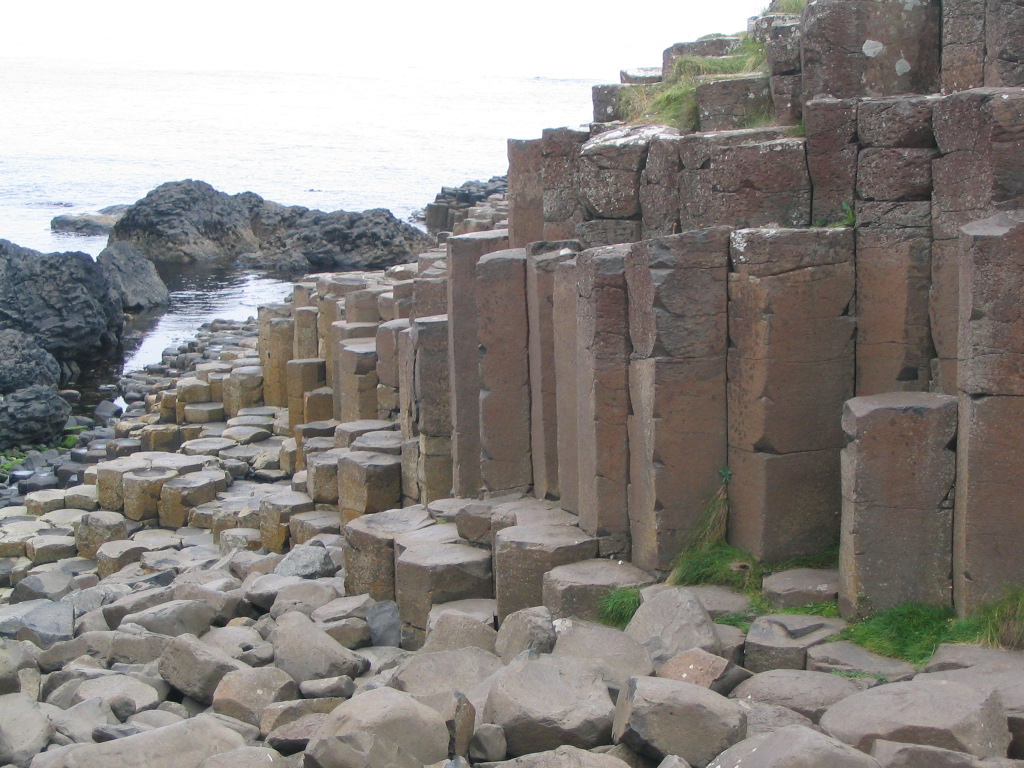
"A giant rock formation resembling a city wall has been discovered under the Taiwan Strait.
The 220m stretch of basalt rock was found by biodiversity researcher Jeng Ming-hsiou. He said it was likely to have been formed by a volcanic eruption up to 1,800 years ago."


Although this latest geological discovery looks as if it was man made there is nothing unusual about how volcanoes seem to have for millenia manufactured man made forms. We often forget how we humans perceive and read the world around us. We have merely reproduced objects based on the inspiring natural forms around us like the basalt blocks on the coast of Hong Kong or the tall square columns in Ireland.


Source
Monday, 1 December 2008

Robert Ballard: Explores the ocean's secrets


"Oceanographer and explorer Robert Ballard takes us on a mindbending trip to hidden worlds underwater, where he and other researchers are finding unexpected life, resources, even new mountains. He makes a case for serious exploration and mapping. Google Ocean, anyone ? "

The image of the map seen here is referred to as a Characterisation of our planet ie a 2D map of the globe without the ocean. This characterisation enables us to view the 72% of the earth we know ever so little about. Robert Ballard in this talk (18 min) frequently points out that we have better detailed maps of the Moon, Mars and Venus then we do of much of our own ocean floor !


Source

Sunday, 26 October 2008

New Solar Energy Storage set to provide Unlimited Solar Power


In a revolutionary leap that could transform solar power from a marginal, boutique alternative into a mainstream energy source, MIT researchers have overcome a major barrier to large-scale solar power: storing energy for use when the sun doesn't shine.

Daniel G. Nocera, Professor of Energy at MIT in collaboration with Matthew Kanan have developed a simple method to split water molecules and produce oxygen gas, a discovery that paves the way for large-scale use of solar power.

In this video Nocera reflects on how photosynthesis works for plant life, which led him to develop a process to use the energy from the sun by splitting water into hydrogen and oxygen gases. Later, when it's needed, the gases can be combined inside a fuel cell. That reconnection creates carbon-free electricity that can be used to power an office building, a home or even an electric car, whether the sun is shining or not.

According to the Professor; The process uses natural materials, is inexpensive to construct and is easy to set up, and, "that's why I know this is going to work. It's so easy to implement.This is the nirvana of what we've been talking about for years, Solar power has always been a limited, far-off solution. Now, we can seriously think about solar power as unlimited and soon."

The researchers developed a new catalyst, consisting of cobalt metal, phosphate and an electrode. When the catalyst is placed in water and electricity runs through the electrode, oxygen gas is produced. When another catalyst is used to produce hydrogen gas, the oxygen and hydrogen can be combined inside a fuel cell, creating carbon-free electricity to power a house or an electric car, day or night.

Thus together with Solar panels are semiconductors (often found on rooftops) that transform sunlight into electricity will effectively establish your house as your own personal power station ?

Source

Saturday, 25 October 2008

Coffee and Milk fractalize in the mix


Next time you stare into your 9am double tall latte, look with new respect

Mary Magsamen and Stephan Hillerbrand make minimalist videos of elements of our everyday existence in their collaborative works;
Coffee & Milk is an experimental video that explores communication and sexuality through the metaphor of everyday items, coffee, milk and children’s music. In Coffee & Milk our lives are transformed into something cinematic and larger than life. Images of blowing milk into coffee and blowing coffee into milk are given an unexpected point of view because the camera is placed underneath us. They could be satellite images of hurricane weather patterns or microscope images.


In cohabitation Michiko Shimokawa and Shonosuke Ohta from Kyushu University in Japan have discovered a new type of fractal in the patterns coffee makes as mixes with milk

Placing a heavier fluid onto a lighter fluid always results in an disturbance at their boundary known as a Rayleigh–Taylor instability.

Wednesday, 22 October 2008

Kakapo: 92 of the World's largest and flightless parrot still breathing ?


The Earth is in the midst of the sixth mass extinction of both plants and animals, with nearly 50 percent of all species disappearing, scientists say.

Among the 11% of the world's endangered species from New Zealand the Kapoto or flightless parrot is teetering on the edge of extinction.

Nevertheless scientists are deciphering the mating behaviours of this bush floor bird and discovering that not only the scent of the male is a mating definition for the female but also the colors of the feathers helps a female decide on a possible conjugation, not discounting the overwhelming boomboom boomings throughout the evening.

Among concerned citizens who are trying to help the Kapoto, scientists say wildlife corridors are urgently needed wherever possible all over the world .

And in the case of the big picture imminent animal and plant species extinction biologists at UC Santa Barbara are working day and night to determine which species must be saved.

Source

Thursday, 3 July 2008

Astronomers Discover Earth Emits acoustic sound waves

Astronomers have discovered that the earth emits an ear-piercing series of chirps and whistles that could (theoretically), be heard by any extra-terrestials who might be listening. The sounds are created by charged particles from the solar wind colliding with Earth's magnetic field, experience these sounds in this video. This phenomena is referred to as Auroral Kilometric Radiation (AKR).


Source

Saturday, 7 June 2008

Sphinx Of Giza Secret Revealed


What they found is unbelievable and the next question is what's underneath Pyramid of Giza ??!!

Sunday, 25 May 2008

Aquaroids, Aquadroids or Underwater Robots


Here are a few Aquaroids Swimming in Fish Tank


Alternatively a very sedate scene of interacting aquadroids


Among 80 robots, at the 2007 Underwater Robot Convention at Tatsumi International swimming pool,Tokyo, were Robotic snake- II, Robotic Flipper, Robotic Snake, Q Diver and Robotic Submarine, (see them here).


Extreme life found at record seafloor depth
Microbes that endure searing heat live a mile below the ocean floor.

Friday, 23 May 2008

Cooked Air, Earthquake Lights or plasma discharge ?


"Earthquake Lights", a phenomenon never recorded before this are seen here as striking colorful (luminous/glowing) cloud phenomenon in the sky was observed about 30 mins before the May 12, 2008 Sichuan earthquake in China took place. This was recorded in Tianshui, Gansu province ~450kmnortheast of epicenter, by someone using a cell phone.


The precise mechanism, if such a phenomenon exists—as opposed to being coincidence with aurora or mistaken recall after a traumatic event such as an earthquake—is unknown. One theory suggests that earthquake lights are a form of plasma discharge caused by the release of gases from within the Earth and are electrically charged in the air.


A map of the locations with sightings of very similar phenomenon.


Here is a more in depth analysis by two scientists studying the phenomena.

Wednesday, 21 May 2008

A "champion" Photonic Crystal Discovered in beetle, for Future Optical Computers

It appears that a simple creature like a beetle provides scientists with one of the technologically most sought-after structures for the next generation of computing. University of Utah chemists determined that an inch-long beetle from Brazil that glows iridescent green because it evolved a crystal structure in its scales that is like the crystal structure of diamonds. Such a structure is considered an ideal architecture for "photonic crystals" that will be needed to manipulate visible light in ultrafast optical computers of the future.

The microscopic image to the right shows individual scales attached to the exoskeleton of the beetle Lamprocyphus augustus, and how the scales glow iridescent green because the fingernail-like material in the scales has a diamond-like crystal structure that reflects green light.

The beetle’s shiny, sparkling green color is produced by the crystal structure of its scales, not by any pigment. The scales are made of chitin, which forms the external skeleton, or exoskeleton, of most insects and is similar to fingernail material. The scales are affixed to the beetle’s exoskeleton. Each measures 200 microns (millionths of a meter) long by 100 microns wide. A human hair is about 100 microns thick.

Researchers are now trying to design a synthetic version of the beetle's photonic crystals, using scale material as a mold to make the crystals from a transparent semiconductor.

Read further and or reflect on this video of a similar type of green iridescent beetle.

Monday, 12 May 2008

Island Of Trash: An Unfathomable Bummer


Some oceanic travelers recently stumbled upon and reported seeing a Texas-sized "island" of trash floating in the Pacific Ocean, this led to some enterprising dudes organizing a reconnoissance mission to where the trash was drifting which turned out being off the West cost of America where limitless volumes of plastic scraps are dispersed throughout the area, hopelessly entangled with the natural environment.

The picture of the map shows the vortex of currents where the trash apparently accumulates and so its quite likely that most of the other oceanic currents in the world will have similar outcomes.

Check out the 12-part Garbage Island video series. In episode nine they enter the gyre.


Source

Next Page

 
Google+
